Showing posts with label child. Show all posts

Wednesday, March 11, 2015

Like this warm weather? Spring is the perfect time to get started mentoring!


Like fishing, swimming, and spending time outdoors?  Like you, many kids can't wait to get outside!  Be a friend to a child age 5-16 and include them as you do your hobbies and sports.  

Below is one child out of the 61 who are currently waiting for mentors with Kids 'n Kinship.

First name:  Jack

Age:  9

Interests:  Jack enjoys going to parks, swimming, fishing, legos, puzzles, and playing with dogs. He also likes building things, floor hockey, basketball, and football and is a Packers fan. He would also like to go to Grandslam or to volunteer at an animal shelter with a mentor.

Personality/Characteristics:  He is smart, fun to be around, and likes to make jokes. Jack lives with his mom, younger brother, & step-dad.  His biological dad is not in his life.  He is looking for an individual mentor preferably with a dog to spend time with him.


Goals/Dreams:  Jack would like to become a police officer.

For more information on Kids 'n Kinship, go to www.kidsnkinship.org.  We have volunteer applications, child profiles, success stories, as well as date of upcoming information sessions to learn more.  The next information session will be March 23, 6-6:45 pm at the Wescott Library in Eagan.  RSVP to Rita rykinship@aol.com

Wednesday, March 4, 2015

Feeling discouraged by your mentee's needs?

I think my mentee needs more than I can give...and I am worried that I am letting her or him down. Am I?

teen male portrait
Question 34 from The Mentor's Field Guide
Every mentoring relationship goes through its ups and downs, and it is a rare mentor who doesn’t get discouraged at times. Sometimes a mentor has unrealistic expectations and is not seeing the changes she had hoped for, or she might worry about how slowly the relationship is progressing. A mentor may also become concerned when the mentee appears to withdraw from the relationship or engages in provocative or inappropriate behavior. It can be natural for the mentor to conclude in such circumstances that she is not being effective when in reality the mentee is just testing her mentor’s commitment.
It is also true that some mentees have more needs than others and that these needs may be beyond the scope of a mentoring relationship. It is not unusual for a mentoring program to either recruit or be faced with referrals for troubled young people with multiple life challenges. Your mentee’s life circumstances may also change significantly during the course of your relationship, placing him under more stress and challenging his coping skills.
One place to start in thinking about your capabilities with your mentee is to examine your expectations and boundaries. You may be taking on too much responsibility for your mentee’s problems. As we have observed, your role is to be a friend. And friendship itself is an important source of support for your mentee, especially if he or she has multiple needs. Your program coordinator may have ideas about strategies you can use with your mentee and can also provide additional moral support as you try them out. It might help to review the first three mentoring stages about the principles for making your relationship work.
It is possible, however, that your mentee needs professional help to cope with stressful situations. Talk to your program coordinator, who can consult with your mentee’s family and school to discuss what services might be needed.
If you are patient and persistent, you are likely to find that the situation improves. It also helps to remember that you are “planting seeds” that may not bear fruit until years later. So, it is difficult to tell right now if you are giving your mentee what she needs.
Reprinted with permission from The Mentor’s Field guide: Answers You Need to Help Kids Succeed by Gail Manza and Susan K. Patrick; Questions about the Mentoring Relationship, Question 34. Reprinted with permission from Search Institute®, Copyright © 2012 Search Institute, Minneapolis, MN; 877-240-7251, ext. 1;http://www.search-institute.org. All rights reserved
For more information on Kids 'n Kinship mentoring program in Dakota County, go to www.kidsnkinship.org

Thursday, February 12, 2015

Mentor's Field Guide - Expectations

Question 19: What should my expectations be for my relationship with a mentee?
guy and boy
Like most mentors, you probably went into this out of a desire to make a difference in a young person’s life. Your desire to help is truly a gift to your mentee, but chances are that you were not exactly sure what “making a difference” looks like. You may have had very modest expectations, such as exposing your mentee to new experiences, or you may have had visions of your mentee achieving high levels of success as an adult. You also may be in a mentoring program that has explicit goals of which you are expected to focus, such as improving school performance or supporting the transition from foster care to independent living. There are many areas in which you can support your mentee.
No matter how long you have been in a mentoring relationship, it helps to step back now and then to examine your expectations: What do you want from the relationship, and what do you think your mentee wants? What exactly are you hoping to achieve? How do you or your mentee want your mentee’s life or behaviors to change because of you? How do you or your mentee define success? How does your role as a friend or “coach” call for a different approach to “helping” than that by a parent, teacher, or professional youth worker?
The more specific you can be in answering these questions, the better you can assess whether your expectations are realistic. In “It’s Not What I Expected” (2007), Boston College’s Renee Spencer demonstrates how counterproductive it can be when mentors fail to establish reasonable expectations for themselves, for their mentee, and for their relationship. But always remember, it is your mentee’s expectations that should drive the relationship, not yours.
Depending on the age of your mentee, you can also mutually set expectations for the relationship. You can ask questions such as, “What would you like to get out of our relationship?” “What kinds of things would you like to do with me?” “Is there anything in your life right now that I can help you with?” “What are your dreams?” “What are your biggest frustrations?” These discussions can set the stage for helping you focus your expectations and helping your mentee think about how to benefit from the relationship with you. These questions can be explored even if the mentoring program already has specific goals like the ones mentioned earlier.
It is particularly important to focus your expectations on developing feelings of trust and closeness in the early stages of your relationship. Building the relationship is the most important work you will do as a mentor and the most successful relationships are those in which mentors take their lead from their mentees.
While it is natural to have goals for the child you want to help, trying to push your mentee to achieve your goals will not only make you seem more like a teacher or parent than a friend, it may also impede the development of the very type of relationship that can be most helpful. There is a further risk, too. Mentors who go into mentoring with an agenda to “change” the mentee run the risk of feeling frustrated, disappointed, and rejected if the hoped-for changes do not materialize. These feelings, in turn, can lead the mentor to conclude that she is being ineffective or that the relationship is not working. Such feelings may be unintentionally conveyed to the mentee, or worse, may lead the mentor to give up on the relationship, thus inadvertently hurting rather than helping the mentee.
One mentor referred to expectations as the Achilles’ heel of mentoring. What he meant was that your expectations and the reality of mentoring may not be in sync after you are in an actual relationship. This discrepancy can lead to feelings of inadequacy on your part and to feelings of frustration or defensiveness in your mentee. And it makes it easy to forget that it is the relationship that is the trans-formative element in your mentee’s life, not actions you take to improve your mentee’s life. Further, it is possible you will never know about the real changes that have taken place unless you happen to see your mentee many years later, and he or she thanks you.
You will be most successful when you keep your goals “on the back burner” so that you can focus on helping your mentee establish his own goals and then provide support and guidance needed to achieve them. This is a fine balancing act, since you may see possibilities for your mentee that he would not see. If you do want to help your mentee raise his aspirations, you can do this most effectively if you “guide” rather that push. It is also very important to remember that mentoring cannot take the place of professional treatment that a troubled person may need.
Reprinted with permission from The Mentor’s Field guide: Answers You Need to Help Kids Succeed by Gail Manza and Susan K. Patrick; Questions about the Mentoring Relationship, Question 19. Reprinted with permission from Search Institute®, Copyright © 2012 Search Institute, Minneapolis , MN ; 877-240-7251, ext. 1;http://www.search-institute.org. All rights reserved.
For more information on getting started mentoring in Dakota County, go to www.kidsnkinship.org or attend an information session Thursday February 19th, 6:00-6:45 pm at Wescott Library in Eagan (1340 Wescott Rd).  Please RSVP to Ingrid Henry 952-891-3885 or ihkinship@aol.com 

Wednesday, February 4, 2015

Like playing in the snow? Be a friend to Zach!

Could this be you enjoying the fresh snow with a kid?

First name:  Zach   

Age:  12

Interests:  Zach likes playing in the snow, basketball and fishing. He is very focused on his studies at school.  He loves animals. When asked why he wanted a mentor Zach said "to get out of the house and do more stuff and meet cool people." 

Personality/Characteristics:  Zach is a remarkable young man - a great communicator, intelligent, athletic and energetic and very very nice. He lives with his single parent mom and his little sister. He needs a positive male role model or couple or family.   


Goals/Dreams:  "To build things, not just with Legos."

Zach is waiting for a mentor through Kids 'n Kinship youth mentoring program in Dakota County.  Mentors are individuals, couples, or families who volunteer to spend time each week with a youth age 5-16 for fun and enriching everyday activities.  To learn more, go to www.kidsnkinship.org.

Thursday, January 29, 2015

100 Ideas to Use When Mentoring Youth


Activities and Conversations to Help Your Mentees Excel
You and your mentee have met, started to get acquainted, and talked in general terms about who you are and what you might do during your mentoring partnership. Now what? The most important thing to remember is that mentoring youth isn’t another meeting or program; it’s a relationship. Effective mentoring is your personal involvement in helping mentees develop and become all they can be. Time spent doing things together—a series of “mentoring moments”—is what will build your relationships and change lives. “Layering” your times and conversations is less intimidating to youth than is a Big Meeting.
by Linda Phillips-Jones, Ph.D., Jean Ann Walth, B.A., & Carlo Walth, B.A., M.Div.© 2001 THE MENTORING GROUP

Thursday, January 15, 2015

How to Motivate Your Mentee with their Schoolwork

 Mentors to young people often play a role in motivating students to do their best in school. Mentoring can improve mentees' attitudes toward school achievement and bolster their belief in their academic ability, according to youth development experts Gail Manza and Susan K. Patrick.
Manza and Patrick, authors of The Mentor's Field Guide: Answers You Need to Help Kids Succeed, write, "Your belief in your mentees and your encouragement can help them to be more willing to make the effort to do well." Mentoring can also increase mentees' aspiration for their future, and when they have goals they would like to achieve, they are more likely to appreciate the role education plays in attaining them.
The following tips, offered by Manza and Patrick, can help mentees see that working hard in school has many benefits:
  • Be specific when talking about school success: turn in assignments on time, actively participate in class, ask for help when needed.
  • Ask what books your mentee is reading; you may have read some of the same books when you were young.
  • Help your mentee engage in problem solving about issues that arise at school.
  • Provide specific help with schoolwork, making sure that you stay in the role as "guide," not "doer."
  • If your mentee claims to not care about school, find out why. Does she believe she isn't smart enough to do well? Does he think he can't afford college?
Keep in mind that academic-related encouragement should not come at the expense of the relationship you are striving to develop with a mentee. Deciding how to help your mentee academically and how involved to get will depend on the wishes of parents, suggestions from teachers, and direction from your mentoring program.

Taken with permission from: The Mentor's Field Guide: Answers You Need to Help Kids Succeed, by Gail Manza and Susan K. Patrick

For more information on Kids 'n Kinship, check out our website: www.kidsnkinship.org

Thursday, December 11, 2014

In Memory of Carol Frick


Carol & Dick Frick with Jan Belmore in 2002
It is with great sadness that we announce that Carol Frick, Kids ‘n Kinship founder, passed away on December 8th, 2014. Carol and her husband Dick started the program in 1972 and because of them thousands of children and youth have benefited from a caring adult mentor. Carol was a truly giving person, who, although she retired from Kids ‘n Kinship 22 years ago, still volunteered helping the program up to the week she died.  Since her retirement from the program, Carol made sure youth received a birthday card and assisted the program with paperwork and newsletter mailings. Carol was a beloved friend and supporter of Kids ‘n Kinship. She will be deeply missed and we are all very grateful that she had the foresight and determination to begin the program.
Carol was honored at the program’s 40th anniversary in 2012 with a piece of artwork
made from fingerprints of the children in the program.

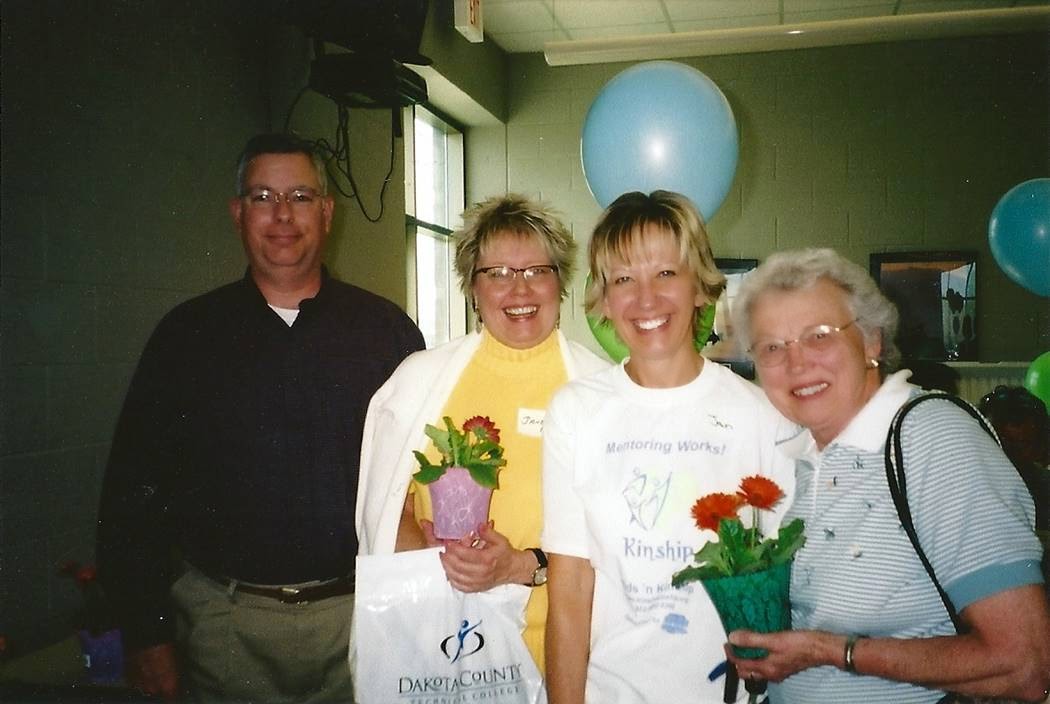
Carol Frick (on the right) with Jan Belmore, Kids 'n Kinship board members

Thursday, November 13, 2014

How Mentors Can Help Youth Develop Assets


Key Principles of Asset Building
Below are some general principles you can use to help your mentee (or any young person in your life) successfully build Developmental Assets.
  • Everyone can help young people build assets- not just parents, teachers, and people with college degrees in child and youth development. Whether you are an electrician or a singer, you have the power to be a positive influence in the life of a young person.
  • All young people need assets. Search Institute’s research shows that almost all young people need more assets than they have. Young people may have lots of friends or achieve high marks in school, but they may be lacking in other areas. Mentors can help them identify strengths and build the assets that are missing in their lives.
  • Relationships are key. Strong relationships between adults and young people, between young people and their peers, and between teenagers and children are central to building assets. As a mentor, you have a significant opportunity to make a difference in your mentee’s life, just by being there for him.
  • Asset building is an ongoing process. It starts when a child is born and continues through high school and beyond. It’s never too late to start building assets with and for your mentee, regardless of her age or what her life has been like up until now.
  • Consistent messages are important. It is important for families, schools, and communities, and others to give young people consistent and similar messages about what is important and what is expected of them. Mentors can play a critical role in exposing young people to positive messages, values, and examples; these messages can be modeled in action by the way you live your life and the way you and your mentee interact with each other and the world around you.
  • Intentional repetition is important. Assets must be continually reinforced across the years and in all areas of a young person’s life. As a significant adult in your mentee’s life, you have a great opportunity to continually reinforce the positive messages and experiences he needs throughout his young life-and beyond.
SOME BASIC TIPS FOR HOW MENTORS CAN BUILD DEVELOPMENTAL ASSETS
  • Remember that the focus of mentoring is on forming a relationship and being a positive adult role model. What you do during your regular visits with your mentee matters less than the fact that you are spending time together and providing your mentee with support and care.
  • Show your mentee that she is a priority by keeping in touch on a regular basis. Even if you cannot be together very often, write letters, send cards, talk on the phone, or send e-mail or text messages.
  • Let your mentee know that you care about things that are important to him. For example, if your mentee has a special friend or pet, ask regularly about how he is doing. If your mentee plays a sport, attend a game or match. If he sings or plays an instrument, ask for a personal recital once in a while.
  • Be flexible. If your mentee has ideas about things to do or ways to do them, let her take the lead. You don’t need a careful plan to build assets.
  • Get to know your mentee’s interests and hobbies. Help him find opportunities to get involved with organized activities or programs that use or develop those interests of hobbies.
  • Talk about and model your personal values. Encourage your mentee to think about the values that are important to her and how those values affect behavior and decisions.
  • Share a new experience together, such as fishing, visiting a local museum (some have days when entrance fees are waived or reduces), taking a class, eating at a new restaurant, or flying a kite.
  • Practice life skills together. For example, prepare a meal together and serve it to your mentee’s family or friends.
  • Emphasize the importance of a lifelong commitment to learning. Go to the library together and check out books to read together. Help your mentee with homework or find someone who can.
  • Talk about some of your hopes and plans for the future and ask about your mentee’s vision of the future. Share ideas with each other about how you can make your respective dreams come true. If it seems as if your dreams can’t or won’t come true, work together to come up with ways to deal with barriers.
  • Enjoy your time together and have fun!
Reprinted with permission from Search Institute®. From Mentoring for Meaningful Results: Asset-Building Tips, Tools, and Activities for Youth and Adults. Copyright © 2008 Search Institute, Minneapolis, MN; 800-888-7828; http://www.search-institute.org. All rights reserved.

Friday, October 24, 2014

Was it your dream to be in the NFL? Be a friend to Chance!

This could be you at a Vikings (or Packers) game with your new friend!
We currently have 56 kids waiting for a mentor!  Please consider coming forward as an individual, a couple, or a family to befriend a child age 5-16 for weekly fun and enriching everyday activities.

Here is just one youth currently waiting...

First name:  Chance

Age:  8

Interests:  Chance enjoys all sports, especially football (he plays flag football), baseball, volleyball, & tennis.  He also loves swimming, Frisbee, ice skating, ice fishing, sledding, &snowboarding.

Personality/Characteristics:  He lives with his mom, & younger sister.  Chance is friendly and social.  He’s in 2nd grade.


Goals/Dreams: Chance’s dream is to be in the NFL.   He’s looking for an active male role model (individual or couple or family) who loves sports. 

For more information, check out Kids 'n Kinship's website www.kidsnkinship.org or call 952-892-6368.  Our next information session is Thursday Nov. 20th, 6-6:45 pm at the Wescott Library in Eagan.  


Monday, July 28, 2014

Kids 'n Kinship Youth Receive Chromebooks through Best Buy grant!

The 2014 Tech Mentor class youth & supporters
Thanks to Best Buy, 6 teens received Google Chromebooks in this year's Tech Mentor program! The youth and their adult supporters (mentors & parents) learned how to use the Chromebooks and created projects to showcase the impact mentoring has had on their lives.  In the final class, youth shared their mentor stories using a projector.  Much thanks to Best Buy Geek Squad Sergey Goldman who was our instructor for the class! Thanks also to Best Buy Apple Valley who hosted the first class and to Keller Williams who hosted the 2nd class!

Agent Sergey instructs the class
 Teens and adult supporters check out their new Chromebooks and learn how to login to Google Drive.


Friday, July 18, 2014

Like bike riding or puzzles? Be a friend to Michelangelo!

Summer is a great time to get started mentoring youth!  If you love spending time outdoors, please consider sharing just an hour or two with youth who are desperate to get outside this summer!  Kids 'n Kinship has 50 kids age 5-16 waiting for someone to spend time with them.  See below for a profile of just one youth:


Name: Michelangelo

Age: 6 

Interests:  Michelangelo enjoys watching movies, playing with legos, puzzles, games, snowball fights, sledding, bike riding, hockey & soccer. 

Personality/Characteristics:  He is fun-loving, friendly, goofy, and active.  He lives with his mom and 4 other siblings. 

Goals/Dreams:  He would love to have a mentor with a snake or a lizard.  His wish is to win the lottery!


For more information: Michelangelo is waiting for a mentor through Kids n’ Kinship in Dakota County. To learn more about this agency, contact Kids n’ Kinship at www.kidsnkinship.org or 952-892-6368. 

For more information about mentoring in your area, contact the Mentoring Partnership of Minnesota at 612-370-9180 or check its online list of mentoring programs at mpmn.org under "Find a Program."

Thursday, July 3, 2014

Get outdoors with youth in need!


Kids 'n Kinship is looking for guys to spend time with youth this summer.  Volunteers meet with a child once a week for fun time doing sports, hobbies, & exploring the great outdoors.  Consider being a friend to a young man like Alvin!

First name: Alvin

Age:  8

Interests:  Alvin loves football, soccer, & baseball.  He also enjoys sledding, bowling, movies, playing games, and going places like GrandSlam & Valleyfair.

Personality/Characteristics:  He is easy-going but active. His three favorite people are Batman, the Hulk, and Spiderman. Alvin lives with his single parent mom and his younger sister who already has a mentor.

Goals/Dreams:  Alvin would like to learn how to snowboard.  He would also love a key to open any door.  He’s looking for a male mentor, couple, or family with older kids to have fun with him.
  

For more information: Alvin is waiting for a mentor through Kids n’ Kinship in Dakota County. To learn more about this agency, contact Kids n’ Kinship at www.kidsnkinship.org or 952-892-6368. 

For more information about mentoring in your area, contact the Mentoring Partnership of Minnesota at 612-370-9180 or check its online list of mentoring programs at mpmn.org under "Find a Program."

Friday, March 14, 2014

Join Kids 'n Kinship for Our Bowlathon!

Kids 'n Kinship is excited to host our 15th Annual Bowlathon in the spring this year! It will be Sunday April 27th, from 3:30-7 pm.  We will have two bowling sessions:

3:30-5 pm for our mentors, mentees, youth on the waiting list, and their families
5:30-7 pm for community teams (youth groups, companies, and friends of the program)$25/person includes bowling, chips & pop, as well as free gift (see below)
Register here: http://kinshipbowlfundraiser14.eventbrite.com

Bowling with us is a great way to get service hours, to bond with your co-workers, or just have fun while making a difference for youth needing mentors in Dakota County! All community bowlers get a lovely commemorative gift like last year's cooler bag:


We are also seeking individuals and companies to sponsor us!  Funds will go directly to supporting youth needing mentors here in our community! Donations will be recognized in our newsletter.
Donate here: http://www.razoo.com/story/Kidsnkinshipbowlathon
For $200, you get a lane sign like in this photo:


Please consider participating by sponsoring us, gathering a team to bowl, or donating an item for our raffle baskets!

For more information on Kids 'n Kinship, check out our website www.kidsnkinship.org

Wednesday, February 12, 2014

Kids 'n Kinship Mentor Wins Be the Change Award!


Congratulations Kids 'n Kinship mentor, Judy Olhoft for being one of 4 winners of the HandsOn Twin Cities Be the Change award for 2014!  She will be given the award this Saturday February 15 at the HandsOn Twin Cities Volunteer Expo at the Mall of America.  The Volunteer Expo runs from 10 am to 3 pm and Kids 'n Kinship's booth will be located in front of Macy's.  Stop by to visit with staff, ambassadors, and mentors and learn more about mentoring youth in Dakota County!

You're also invited to attend the Awards Ceremony from 1-1:30 pm at the Rotunda to see Judy accept her award, along with her mentee.  THANKS FOR EVERYTHING, JUDY!


To learn more about Kids 'n Kinship, visit our website www.kidsnkinship.org. You're also invited to an information session on Thursday Feb. 20, 6-6:45 pm at the Burnhaven Library in Burnsville. To RSVP, call  or call 952-891-3885.


Tuesday, February 4, 2014

Developmental Stages of Young People: Part Three

RELATIONSHIPS WITH OTHERS
Generally, 10- to 12-year-olds still enjoy being around family members. This is typically the age when romantic relationships start to become of interest, and friends and peers become even more important in their lives. As young people mature, they begin to actively seek out ways to be more independent of their family and to bond more closely with peers.

Tips for interacting with your mentee:
  • At this age, young people are beginning to think like adults, but they don’t have the experience and judgment needed to act like adults. Help your mentee recognize this.
  • Suggest constructive behaviors, but provide multiple options to allow your mentee to make choices. For example, describe the positive aspects of helping a younger child with homework, doing chores without being asked, or volunteering with a friend at a local charity.
  • Never give up on your mentee, even when things get tough.
for-children-teens-and-adults
Reprinted with permission from Search Institute®.  From Mentoring for Meaningful Results: Asset-Building Tips, Tools, and Activities for Youth and Adults. Copyright © 2008 Search Institute, Minneapolis, MN; 800-888-7828; www.search-institute.org. All rights reserved.

Friday, January 31, 2014

Developmental Stages of Young People: Part Two

DECISION MAKING FOR THE SHORT TERM AND THE FUTURE
Adolescents typically start to understand the consequences of different actions by about age 13 or 14. At this age they also are increasingly considering who they are in the world. As they age, adolescents mature in their ability to think through problems on their own. By the time people are close to 17 or 18 years old, they are both excited and scared to be on their own.
TEEN-COMPLEXION
Tips for interacting with your mentee:
·        Encourage her to take responsibility for her actions.
·        Help him make good choices, like getting his homework done before you do a fun activity together.
·        Suggest that your mentee break planning and decision making down into a series of steps.
·        Ask questions that highlight the positive results of good decisions and the unpleasant consequences of poor planning.
·        Listen carefully without criticizing.
·        Listen to you Mentee’s thoughts about the future.
·        Support and respect his decisions.
·        Offer ideas about what you think she might like to do or be good at.
·        Find other mentors who can help direct his choices.
·        Share your own excitement about the world and its possibilities.
*Look for part three next week.
Reprinted with permission from Search Institute®.  From Mentoring for Meaningful Results: Asset-Building Tips, Tools, and Activities for Youth and Adults. Copyright © 2008 Search Institute, Minneapolis, MN; 800-888-7828; www.search-institute.org. All rights reserved.

For more information on Kids 'n Kinship mentoring program in Dakota County, go to www.kidsnkinship.org

Thursday, January 9, 2014

January is National Mentoring Month!


January 2014 is the 13th Annual National Mentoring Month.  Today, January 9th, is National I am A Mentor Day.  All across the country people are recognizing the important role mentors play in the success of our nation's youth.  Every day, mentors in communities across our nation provide crucial support and guidance to young people. Whether a day is spent helping with homework, playing catch or listening, these moments can have an enormous, lasting effect on a child’s life. You don’t need special skills to be a mentor. You just need to listen, show that you care and share your experience.

Do you remember being mentored unofficially or officially as a child?  Thank your mentor on National Thank Your Mentor day, Thursday January 16th.  For more information on National Mentoring Month, go to: http://www.mpmn.org/Events/NationalMentoringMonth.aspx

Make a difference to a child, consider becoming a mentor to a youth in Dakota County through Kids ‘n Kinship! We are a local non-profit organization that matches kids ages 5-16 with volunteer mentors for fun and engaging weekly activities in the community. In addition to the community-based program, Kids ‘n Kinship offers school-based mentoring programs at Glacier Hills and Thomas Lake Elementary Schools in Eagan, Westview Elementary in Apple Valley, and Parkview Elementary in Rosemount.

Research has shown that when matched through a quality mentoring program, mentors can play a powerful role in providing young people with the tools to make responsible decisions, stay focused and engaged in school, and reduce or avoid risky behavior like skipping school, drug use and other negative activities. Quality mentoring relationships lead to a significant increase in a young person’s prospects for leading a healthy and productive life, strengthening families and, ultimately, our community.

All of these factors are encompassed in this year's theme Mentoring Works! Additionally, a study done by Science Daily found that for all teen students, having an adult mentor meant a 50 percent greater likelihood of attending college. After more than 41 years of serving children in Apple Valley, Burnsville, Eagan, Farmington, Lakeville and Rosemount, Kids ‘n Kinship has many success stories. 

Here's a few testimonials: 
“My son’s mentor is very supportive and is a great role model.  I see my son looking up to him and he is doing better in school this year” - Parent

“[Her mentor] has really made a difference in [my daughter’s] life, I’m so grateful to her!  She ‘gets’ her,” - Parent

“Our personalities are so similar, she’s just like me when I was that age.” - Mentor

“My mentee is an amazing young woman, I am really proud of her - she has a good perspective and is set to graduate this spring.”  - Mentor

“She is delightful and fun to be with!  I’m enjoy her immensely…she’s just a riot, she’s very funny!” - Mentor

“[He] has started out the school year with the most positive attitude he has ever had!” - Parent

“She is a sweet girl with a loving heart.  In addition to meeting at school, we like to bake, and do crafts in the winter.  We enjoy riding bike together during the summer and just being outside.” - School-Based Mentor

For more success stories and to read about how to started with Kids 'n Kinship, go to our website: www.kidsnkinship.org

Consider attending an information session to hear more!  Our next one is Thurs. Jan. 23rd, 6-6:45 pm - Burnhaven Library in Burnsville.  RSVP to Ingrid Henry 952-891-3885

Thursday, December 19, 2013

Can you help Maggie navigate the murky waters of the teen years?


Kids 'n Kinship has nearly 50 youth waiting for mentors in Apple Valley, Burnsville, Eagan, Farmington, Lakeville and Rosemount.  Heading into the new year, would you consider spending time once a week with a teen or child?  All it takes is a desire to be their friend, someone they can count on and have fun with.  You can even mentor with your spouse or family.

Here’s one of the youth waiting for that special friend:

First name:  Maggie

Age:  14

Interests:  Maggie is a huge fan of the band One Direction.  She also loves swimming, biking, doing crafts, going to parks, and visiting historical museums. She loves animals, though she only has a fish for a pet. She misses her cat and would love a mentor with a cat, dog, or turtle as a pet.

Personality/Characteristics:  Maggie is sweet and a little shy. She lives with her grandparents and is looking forward to having a mentor individual or couple to have someone else to talk to and hang out with.

Goals/Dreams:  Her wishes are to live with her sister and to have her cat back.

Looking For: An individual or couple, preferably with pets, to help her with friendship skills and self-confidence.

For more information: Maggie is waiting for a mentor through Kids n’ Kinship. To learn more about mentoring Maggie or another child contact Kids n’ Kinship at www.kidsnkinship.org or 952-892-6368. 


Photos by DigitalArt, courtesy of FreeDigitalPhotos.net


Wednesday, November 27, 2013

Kids 'n Kinship Thanks Our Supporters!


With Thanksgiving fast approaching, I want to take this opportunity to share how thankful Kids 'n Kinship is for all of our sponsors, donors, and volunteers who have supported us this year!

There are simply too many to list them all here, but we are so appreciative of each supporter who gave time, goods, or money to help Kids 'n Kinship continue our mission of matching youth with positive role models here in Dakota County!

We had a very busy but successful autumn raising $22,000 from our 2013 Gala and another $6,000 from our 2013 Bowlathon.  Many thanks to our sponsors & in-kind donors for the Bowlathon! 

Sponsors:
AAA Minnesota Iowa
Wayne and Carole Stockman
Thrivent Financial
US Federal Credit Union
Eagan Lions
KleinBank
Robert A. Bjorkman, DDS
Burnsville Women of Today
The Credit Department, Inc
First Presbyterian Church
Marshall Nelson and Associates
In-Kind Donors:
Cedarvale Lanes
Media Relations
JJ Taylor
Merchant’s Bank
UTC Aerospace
Mackin Media Library
Barnes & Noble
Peeps & Company
137 Kids 'n Kinship Participants and community members bowled that day and had a wonderful time!  Our raffle baskets & silent auctions baskets were a huge hit, bringing in $675 for Kids 'n Kinship!  We especially enjoyed have the Peeps Mobile there with giveaways for kids and Nicole, Kelley & Amanda's volunteering with us that day!

It's not too late to donate to the bowlathon! http://www.razoo.com/story/Kidsnkinshipbowlathon

THANK YOU for your support!

Special thanks to our volunteer mentors who volunteer an hour or two a week to be a friend to a child! Thanks to you, 79 youth currently have someone to look up to, have fun with, and someone who believes in them! 

50 more youth are waiting for a mentor.  Please contact us today to find out more about how you can step in to a child's life and make a difference!  Our next information session is Monday December 9, 6-6:45 pm at the Wescott Library in Eagan. RSVP to Rita 651-686-0990. For more information, go to  www.kidsnkinship.org

Friday, September 20, 2013

The 2013 College Football Coaches Challenge is Underway!


Kids 'n Kinship is proud to be one of 10 Expert Partner mentoring programs teaming up with the Mentoring Partnership of Minnesota and the University of Minnesota in the 2013 Coaches Challenge!

The challenge is geared towards recruiting mentors for top mentoring programs in the stateGophers Football Coach Jerry Kill is challenged off the field by his peers in Iowa, Nebraska, Michigan and Kansas. Coach Kill has entered a “Coaches Challenge” to recruit more mentors for Minnesota’s youth. Coach Kill, MPM and the mentoring programs will work to close the mentoring gap for more than 250,000 Minnesota young people who could benefit from a mentoring relationship.  

This Coaches Challenge could be especially helpful in recruiting men for the many boys on our waiting list. Did you know that two times as many women mentor than men? And yet 29% of boys wait a year or more to be matched with a mentor.  Men, think of the types of important talks you have had with other men & role models, perhaps a coach or an uncle or a family friend. Now, imagine a young boy not having that opportunity.  You can provide that for them.  Visit www.BeAMentorMN.com to sign up today!

For more information on Kids 'n Kinship explore our website, www.kidsnkinship.org.  We have information sessions scheduled for Tues. Sept. 24 at the Galaxie Library in Apple Valley (14955 Galaxie Ave.) and Thurs. Oct. 10 at the Burnhaven Library in Burnsville (1101 W. CR-42), both from 6:00-6:45 pm.